Understanding the Basics of 40 Inches
When a number like 40 inches appears on a growth chart, a shipping label, or a piece of furniture, it can feel oddly disconnected from anything we can actually picture. Measurements only become meaningful once we translate them into something familiar, something we can hold in our mind’s eye. That is really the purpose of this guide, to take a plain figure and give it warmth, context, and clarity. By the end, 40 inches should feel less like an abstract statistic and more like something you genuinely understand.
40 Inches Is How Tall in Feet
The most common question people ask is simply, 40 inches is how tall in feet, and the answer is refreshingly straightforward once you know the formula. Since a foot contains 12 inches, dividing 40 by 12 gives you approximately 3.33 feet. Expressed more naturally, that comes out to 3 feet and 4 inches. It is not a clean, whole number, which is part of why the conversion can feel slightly awkward at first, but once broken down it becomes very easy to remember.
Converting 40 Inches Using Simple Math
If you ever want to convert inches to feet on your own, the process never changes no matter which number you start with. You simply divide the total number of inches by 12, since that is the fixed relationship between the two units. For 40 inches, this division leaves you with a whole number of 3 and a remainder of 4, meaning 3 feet and 4 leftover inches. Practicing this same method with other numbers will make future conversions feel almost automatic.
Why Inches and Feet Coexist as Units
It might seem strange that we use two different units, inches and feet, to describe the same kind of measurement, but there is a practical reason behind it. Inches allow for fine, precise detail, which matters greatly when measuring something small like a child’s growth or a piece of hardware. Feet, on the other hand, are more useful for larger distances where extreme precision matters less. Together, they give us a flexible system that adapts comfortably to very different situations.
How Much Height Is 40 Inches for a Person?
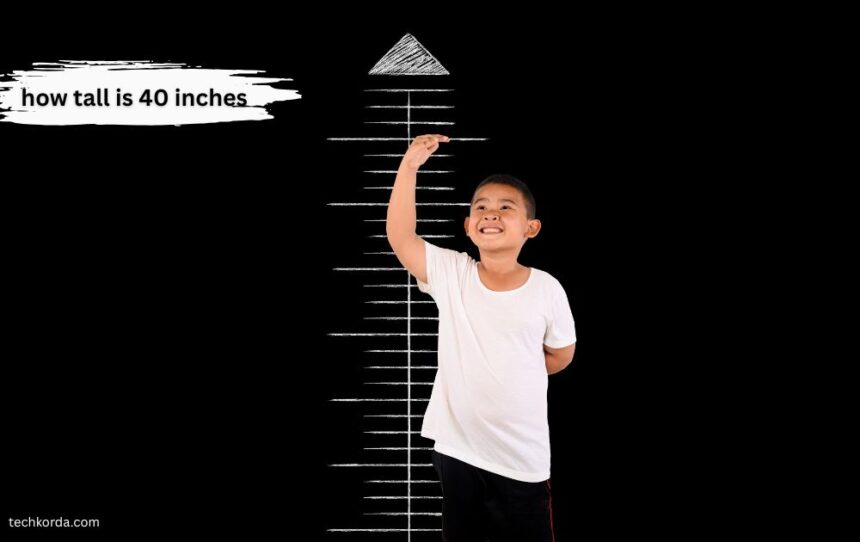
Many people asking How Much Height Is 40 Inches for a Person are really trying to picture a person rather than just a raw number. In practical terms, 40 inches is far below the typical height of an adult, but it aligns closely with the height of a young child. This is why the figure shows up so often in conversations about toddlers, growth milestones, and children’s products rather than adult sizing charts. Picturing a small child standing beside a taller adult gives a fairly accurate sense of the scale involved.
40 Inches and Toddler Growth Stages
Around the age of two to three years old, many toddlers reach a height somewhere close to 40 inches, though the exact age varies quite a bit from child to child. Growth during these early years tends to happen in gentle, sometimes uneven bursts rather than a perfectly steady climb. Genetics, nutrition, and overall health all play a role in when a child reaches this particular height. Because of this natural variation, there is no single “correct” age at which a child should measure exactly 40 inches.
Comparing 40 Inches to Average Adult Height
For context, the average adult height is considerably taller than 40 inches, often ranging somewhere between 5 feet and just over 6 feet depending on gender and geography. This means 40 inches would only reach roughly the waist or hip area of a typical adult standing nearby. Seeing this comparison helps explain why 40 inches is rarely used to describe adult stature and instead appears far more often in discussions involving children, furniture, or everyday objects.
What 40 Inches Looks Like in Centimeters
For those more familiar with the metric system, 40 inches converts to approximately 101.6 centimeters, since each inch equals about 2.54 centimeters. This conversion can be especially helpful for readers outside the United States, where centimeters are the standard unit for height and length. Having both figures side by side, inches and centimeters, makes the measurement accessible no matter which system feels more natural to you.
Visualizing 40 Inches Through Everyday Objects
One of the most effective ways to understand any measurement is to compare it to ordinary objects you encounter throughout your day. A height of 40 inches is fairly close to the height of a standard kitchen countertop, a tall bar stool, or a small side table. These everyday comparisons transform an abstract number into something tangible, something you can practically reach out and touch in your own home.
40 Inches and Kitchen Countertops
Kitchen countertops in most homes typically stand somewhere between 34 and 36 inches, which places 40 inches just slightly above that familiar surface. If you picture a countertop and then imagine adding a few extra inches, you land almost exactly on 40 inches. This particular comparison tends to resonate with people because kitchen counters are such a common, shared point of reference in daily life.
40 Inches and Furniture Dimensions
Beyond kitchens, furniture such as dining chairs, small bookshelves, and certain desks often hover near the 40 inch mark in height. Interior designers frequently work with this range when planning spaces that feel proportionate and comfortable for the human body. Understanding this connection can be genuinely useful if you are shopping for furniture and want a clearer mental picture of how a piece might actually look once placed in your room.
40 Inches in the Context of Doorways and Railings
Certain functional elements of a home, such as stair railings or half height doors, are also designed with measurements close to 40 inches in mind. Building codes in many regions require railings to reach a specific height range for safety, and 40 inches often falls near that threshold. This shows how the measurement extends well beyond human height and into the practical world of architecture and home safety.
Comparing 40 Inches to Pets and Animals
Interestingly, 40 inches can also describe the height of certain larger dog breeds when measured at the shoulder, or the length of some mid sized animals nose to tail. This comparison offers another relatable way to visualize the measurement, especially for pet owners who already have a strong sense of their own animal’s size. It reinforces the idea that 40 inches sits in a very specific, moderate range, neither tiny nor especially large.
Understanding Growth Charts and What They Mean
Pediatric growth charts plot a child’s height against age and compare it to a broader population of children the same age, offering a percentile rather than a fixed target. A measurement like 40 inches might place one child in a higher percentile and another in a lower one, depending entirely on their individual age and growth pattern. These charts are meant to track trends over time rather than serve as a strict benchmark that every child must meet.
Why Every Child Grows at Their Own Pace
It bears repeating that children grow according to their own unique timeline, shaped by a combination of genetics, environment, and overall health. Some toddlers reach 40 inches earlier than their peers, while others take a bit longer, and both scenarios can fall well within the range of normal, healthy development. Comparing children too closely to one another based on height alone rarely tells the full story of their growth or wellbeing.
The Role of Genetics in Height
Genetics play the leading role in shaping a person’s eventual height, largely inherited from parents and extended family. This natural blueprint explains why height can vary so much from one child to another.
- Parental height is one of the strongest predictors of a child’s future height
- Genes set a natural range rather than one fixed number
- Environmental factors support this range but rarely override it
- Height differences between same age children are usually normal, not concerning
Nutrition’s Influence on Growth
Alongside genetics, proper nutrition during childhood plays an important supporting role in helping a child reach their natural growth potential. A balanced diet rich in essential vitamins, minerals, and protein supports healthy bone development during these formative years. While nutrition cannot override genetic limits entirely, consistent poor nutrition can sometimes slow growth, which is why pediatricians often discuss diet alongside height during routine checkups.
Sleep and Its Connection to Growing Bodies
Sleep is another quiet but important factor in a child’s physical development, since growth hormone is released most actively during deep sleep. Toddlers and young children generally need significantly more sleep than adults, often between eleven and fourteen hours depending on their age. Ensuring consistent, restful sleep supports not only height but overall physical and cognitive development during these early years.
Why Height Alone Doesn’t Define Wellbeing
It is worth gently reminding ourselves that height, whether 40 inches or otherwise, is only one small piece of a much larger picture of health and happiness. A child’s emotional wellbeing, developmental milestones, and overall vitality matter far more than where they land on a growth chart. Numbers can offer useful guidance, but they should never become a source of unnecessary worry or comparison.
Measuring Height Accurately at Home
If you want to measure height accurately at home, it helps to have the person stand barefoot against a flat wall with their heels, shoulders, and head touching the surface. A flat object like a ruler or book can then be placed level on top of the head, marking the wall at that exact point. Measuring from the floor to that mark with a tape measure will give you a fairly reliable result, especially when done in the morning before the body slightly compresses throughout the day.
Common Mistakes When Measuring Height
Small errors during measurement can throw off the final number more than people expect. Being aware of these common slip ups helps keep results accurate and consistent over time.
- Measuring with shoes or thick socks still on
- Allowing the person to slouch or bend their knees
- Using a soft, bendable tape measure against the wall
- Measuring at different times of day, since height shifts slightly by evening
40 Inches in Product Descriptions and Shopping
Outside of human height, 40 inches shows up constantly in product listings, from television screens to luggage dimensions to the length of curtains and drapes. Shoppers often rely on this figure to judge whether an item will physically fit within their intended space before making a purchase. Understanding what 40 inches actually looks like in real life can make online shopping feel far less uncertain and far more intuitive.
Why Retailers Use Inches for Sizing
Retailers in the United States continue to rely heavily on inches for product sizing largely because it remains the standard unit of measurement across the country. This consistency helps customers compare products more easily without needing to convert units every time they shop. For international shoppers, however, this can occasionally create a small learning curve, which is part of why side by side conversions to centimeters are so commonly included.
Height Measurements Across Different Countries
While the United States continues to favor inches and feet, most other countries around the world rely on the metric system, measuring height in centimeters instead. This difference occasionally causes confusion when comparing products, growth charts, or even conversations between people from different regions. Knowing that 40 inches equals roughly 101.6 centimeters bridges that gap and makes the measurement understandable no matter where you happen to be.
Putting It All Into Everyday Perspective
Bringing everything together, 40 inches translates to about 3 feet 4 inches, or roughly 101.6 centimeters, and it most closely resembles the height of a young toddler rather than an adult. It also lines up closely with familiar objects like kitchen counters, certain furniture pieces, and some larger pets. Viewed through these everyday comparisons, the measurement stops feeling abstract and instead becomes something genuinely easy to picture.
Final Thoughts on 40 Inches
At its core, understanding a measurement like 40 inches is really about connecting numbers to real, lived experience rather than treating them as cold, isolated facts. Whether you are tracking a child’s growth, shopping for furniture, or simply satisfying a moment of curiosity, having a clear and gentle explanation makes all the difference. Hopefully this guide has given you exactly that, a warm, grounded sense of what 40 inches truly means.