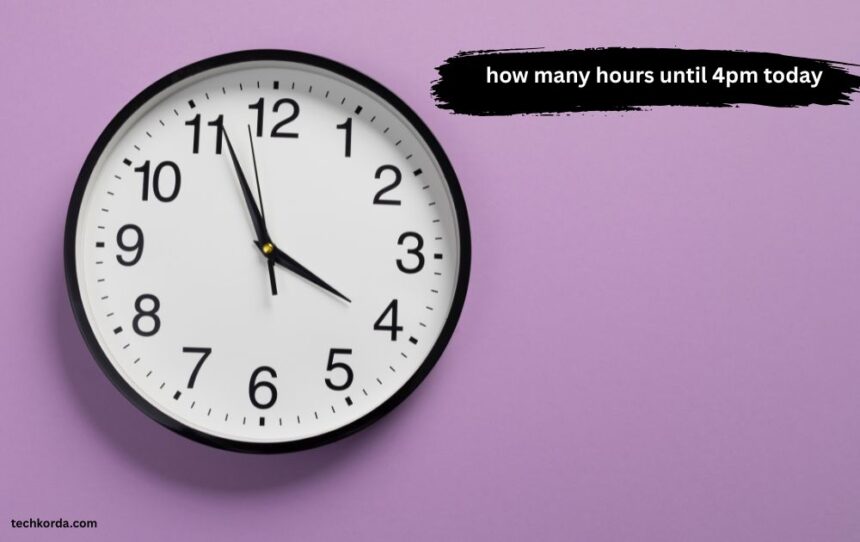
Finding Calm in the Simple Question of Time
There is something quietly soothing about pausing in the middle of a busy day to ask how many hours until 4pm today, because the question itself slows us down for just a moment. It turns a vague sense of “later” into something we can actually picture, a specific point on the clock we are moving toward. Whether you are watching the hours pass at a desk, waiting for a loved one to call, or simply curious about how much daylight remains, this small act of counting gives shape to an otherwise formless afternoon. It is less about urgency and more about orientation, a gentle way of knowing where you stand in your day.
Why We Ask How Many Hours Until 4PM Today
People search for how many hours until 4pm today for all sorts of reasons, and most of them are refreshingly ordinary. A student might be counting down to the end of a long study session, while a parent tracks the hours until school pickup begins. Someone else might simply be marking the transition from a hectic morning into a calmer, more relaxed evening. Whatever the reason, the question reflects a very human habit of anchoring ourselves to specific moments rather than letting time drift by unnoticed. It is a small way of staying present while still looking forward.
The Simple Math Behind Counting the Hours
Figuring out how many hours until 4pm today does not require anything complicated, just a bit of straightforward subtraction using the 24-hour clock. Since 4pm corresponds to the 16th hour of the day, you simply subtract the current hour from sixteen to find your answer. If it is 10am, for instance, you have six hours remaining before the moment arrives. If it is already past 4pm, the countdown naturally resets and starts pointing toward tomorrow instead. This little bit of arithmetic, though basic, is often all people need to feel a sense of progress through their day.
How Many More Hours Until 4PM Today Shifts With Your Morning
The answer to how many more hours until 4pm today naturally changes depending on when you happen to ask, which is part of what makes the countdown feel alive rather than static. Early risers checking the time at dawn will find themselves facing a much longer stretch than someone who wakes closer to noon. This shifting number can actually be motivating, since watching it shrink hour by hour offers a quiet, steady sense of forward motion. It becomes less about the destination itself and more about noticing the steady rhythm of a day unfolding exactly as it should.
A Midday Look at How Many Hours Are Left
By the time midday arrives, the countdown often starts to feel more tangible, since half the workday or school day has typically already passed. Checking in around noon or early afternoon tends to reveal a smaller, more manageable number, which can bring a welcome sense of relief after a demanding morning. This is often the point where people begin planning the rest of their day around the approaching hour, whether that means wrapping up tasks, preparing for a meeting, or simply looking forward to a change of pace. The midday check-in becomes a small checkpoint of reassurance.
The Final Countdown Toward the Afternoon
As the clock creeps closer to 4pm, the remaining hours start to feel shorter and more immediate, often just a matter of one or two hours rather than a distant stretch. This final countdown carries its own particular energy, a sense that the day is rounding a corner toward its later chapters. For many people, this is when focus sharpens and motivation rises, since the finish line finally feels within reach. There is a comfort in knowing that whatever the day has held so far, the approaching hour marks a natural shift into its next phase.
Why 4PM Feels Like a Turning Point
There is a reason so many people fixate on 4pm specifically rather than any other hour, and it likely has to do with how the day naturally divides itself around that time. It often marks the boundary between focused, task-driven hours and the softer, more relaxed hours that follow. For office workers, it can signal the final stretch before heading home, while for others it marks the beginning of evening routines, family time, or a well-earned pause. In many cultures, 4pm quietly carries the feeling of an afternoon exhale, a gentle turning point rather than a hard deadline.
Using a Countdown Tool Instead of Counting in Your Head
While the math behind how many hours until 4pm today is simple enough to calculate manually, many people prefer using an online countdown tool for the sake of convenience and accuracy. These tools remove any guesswork, automatically factoring in your current time zone and updating in real time as the minutes pass. This can be especially helpful during busy or distracted moments, when doing mental arithmetic feels like one task too many. A quick glance at a countdown widget offers the same reassurance as checking a clock, only with the answer already calculated and waiting for you.
Time Zones and Your Personal 4PM
It is worth remembering that 4pm does not arrive at the same moment for everyone, since time zones scatter the hour across the globe in staggered waves throughout the day. Someone in one city might be closing their laptop for the evening while someone else, several time zones away, is only just sitting down to lunch. This becomes especially relevant for remote teams, long-distance relationships, or anyone coordinating plans across different regions. Being mindful of these differences ensures that “4pm” always refers to the correct 4pm, the one that actually matters for the moment you are counting toward.
The Psychology Behind Watching the Clock
There is genuine psychological comfort in tracking time this closely, since research on time perception suggests that having a clear reference point can reduce feelings of uncertainty or restlessness. When a day feels long and undefined, anxiety can quietly creep in, but breaking it into a specific countdown gives the mind something concrete to hold onto. This is part of why people count down to appointments, deadlines, or even the end of a long commute. Asking how many hours until 4pm today is, in its own small way, a form of self-soothing through structure and clarity.
How Waiting Rooms and Workdays Shape Our Sense of Time
Certain environments seem to stretch time in ways that make countdowns especially appealing, and waiting rooms, classrooms, and long workdays are classic examples. When the surroundings offer little to occupy the mind, the hours can feel heavier and slower than they actually are. In these moments, having a clear countdown toward 4pm, or any other meaningful hour, can offer a welcome sense of control. It transforms an open-ended wait into a measurable, finite stretch, which somehow always feels easier to sit with than uncertainty ever does.
Turning a Countdown Into a Moment of Mindfulness
Rather than treating the countdown as a source of impatience, it can gently be reframed as an invitation to notice the present moment more closely. Instead of simply waiting for 4pm to arrive, you might use each hour as it passes to check in with how your day is actually going. Are you rested, focused, in need of a short break, or simply moving along steadily? Approached this way, the countdown becomes less about rushing toward the future and more about staying gently aware of the time you are already living through.
Practical Reasons People Track This Countdown
Beyond curiosity, there are plenty of practical reasons someone might want to know how many hours until 4pm today, from scheduling a phone call to planning when to start dinner. Parents often use it to prepare for school pickups, while professionals rely on it to pace out the final tasks of their workday. Others might be counting down to a scheduled break, a doctor’s appointment, or simply the moment they can step outside and enjoy some fresh air. In each case, the countdown serves as a small, quiet organizing thread running through an otherwise busy day.
How Many Hours Until 4PM Today on a Weekend
On weekends, the question tends to take on a softer, more relaxed tone, since 4pm often marks the golden hour of a lazy afternoon rather than the end of a structured obligation. People might be counting down to a get-together with friends, the start of a favorite weekend show, or simply the moment the day begins cooling into evening. Without the pressure of work deadlines attached, the countdown becomes less about productivity and more about anticipation, a gentle marker for whatever leisurely plans the rest of the day might hold.
Seasonal Light and Why 4PM Feels Different in Winter and Summer
Interestingly, the character of 4pm itself changes throughout the year, shaped heavily by the season and the amount of daylight available. In the summer months, 4pm often still feels like the height of the afternoon, bright and full of energy. In winter, however, the same hour can already carry hints of dusk, with the sky beginning its slow fade toward evening. This seasonal shift adds a quiet layer of meaning to the countdown, since the 4pm you are counting toward in July feels noticeably different from the one waiting for you in December.
Letting Go of Clock Watching Anxiety
While countdowns can be comforting, it is worth gently noting that constant clock-watching can sometimes tip into unnecessary stress if it becomes the sole focus of your attention. If checking how many hours until 4pm today starts to feel more anxious than reassuring, it may help to check in less frequently and trust that the hours will pass regardless. Setting a single reminder or glancing at the countdown only once or twice can offer the same sense of orientation without the pressure of constant monitoring. Time has a way of moving forward on its own.
Making Peace With However Many Hours Remain
Whether the countdown reveals one hour or eight, there is a quiet kind of peace available in simply accepting the number as it is, rather than wishing it were smaller. Each remaining hour holds its own small opportunities, whether that means finishing a task, resting for a moment, or simply being present with whatever the day brings. The goal is not to rush past the hours but to move through them with a little more ease, knowing that 4pm, like every other point on the clock, will arrive exactly when it is meant to.
Conclusion
In the end, asking how many hours until 4pm today is less about the number itself and more about the small comfort of knowing where you stand within your day. The hours will pass steadily whether you track them closely or let them drift by unnoticed, but there is something gently grounding about choosing to pay attention. So the next time you find yourself wondering how many more hours until 4pm today, let the countdown be a quiet companion rather than a source of pressure, a simple reminder that time is moving, and so are you, one steady hour at a time.