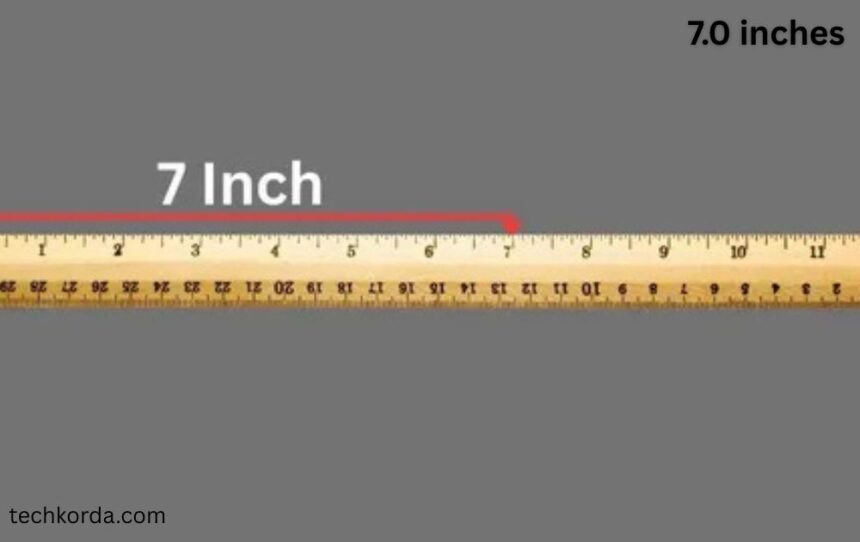
Measurements have a way of slipping quietly into daily life without ever asking for attention. Seven inches is one such figure modest, familiar, and easy to overlook until it becomes exactly what a task requires. This measurement can be useful for everyday items such as compact screens, photo frames, and storage containers, making it a familiar and practical size. Understanding what it means in millimeters, and how a smaller figure like 0.7 inch behaves in the same system, opens a door into the calm logic that measurement systems are built upon.
What Exactly Is an Inch
An inch is a unit from the imperial measurement system, which remains commonly used in places like the United States. It is often pictured as the length of a thumb from the knuckle to the tip, though its modern definition is far more exact than that old rule of thumb suggests. Inches are commonly used for describing screen sizes, paper dimensions, and everyday hardware. Despite the global shift toward metric measurement, the inch remains deeply woven into daily language and design.
What Exactly Is a Millimeter
A millimeter, by contrast, belongs to the metric system, a method built on powers of ten that many countries rely on for its simplicity. It is a small unit, roughly the thickness of a credit card, yet it plays an outsized role in fields where precision cannot be compromised. Millimeters appear constantly in manufacturing drawings, medical instruments, and scientific measurement. Its consistency across the world makes it a natural counterpart to the more regionally rooted inch.
The Fixed Bridge Between Inches and Millimeters
A single unchanging number allows these two systems to communicate smoothly: one inch equals exactly 25.4 millimeters.
- This value was formally standardized decades ago, closing the door on older regional variations.
- Converting inches to millimeters becomes a simple multiplication, and the reverse becomes an equally simple division.
- This fixed relationship lets figures like 7.0 inches and 0.7 inch find their millimeter counterparts without confusion.
Translating 7.0 Inches Into Millimeters
Using the standard conversion factor, 7.0 inches is equivalent to 177.8 millimeters.This number emerges by multiplying seven by 25.4, a calculation that holds true no matter how many times it is repeated. For anyone working between two measurement systems, this kind of conversion offers reassurance rather than complication. It transforms a familiar imperial length into its metric equivalent without losing any of its original meaning or accuracy.
Common Everyday Uses of 7.0 Inches
Seven inches, or its metric twin of 177.8 millimeters, appears more often in daily life than most people realize.
- Certain picture frames and some smartphone diagonals hover near this range too.
- Recognizing this measurement in both systems helps when comparing imported products or reading foreign specification sheets.
Understanding 0.7 Inch to MM
For smaller measurements, the same conversion method can be used to find the millimeter equivalent of 0.7 inches. Multiplying 0.7 by 25.4 produces 17.78 millimeters, a figure that may seem tiny but often carries real significance. Fractions of an inch like this frequently appear in specifications for small components, fasteners, or decorative items. The consistency of the conversion formula means accuracy is preserved even when the numbers themselves shrink considerably.
Why 0.7 Inch to MM Matters in Precision Work
In fields where tolerances are measured in fractions rather than whole numbers, a conversion like 0.7 inch to mm becomes genuinely important. Jewelry makers, electronics technicians, and mechanical designers often work with components this small, where a slight miscalculation can lead to a part that simply does not fit. Knowing the precise millimeter equivalent allows for confident cross referencing between imperial tools and metric blueprints. Precision at this scale is rarely dramatic, but it is consistently essential.
Applying 0.7 Inch to MM in Design
Designers working across international markets often encounter specification sheets that mix inches and millimeters within the same document. Being able to quickly convert 0.7 inch to mm allows for smoother collaboration between teams that may be more comfortable in one system than the other. This small act of translation prevents costly misunderstandings during manufacturing or assembly. It also reflects a broader habit in design work: treating even the smallest measurements with the same care as the largest ones.
Flipping the Equation: 0.7 MM to Inches
Sometimes the direction of conversion reverses, and the starting point is metric rather than imperial For an approximate inch equivalent, 0.7 millimeters can be divided by 25.4, which comes to roughly 0.0276 inches Although this number looks unfamiliar at first glance, it follows the same dependable logic used in every other conversion. This reverse calculation is especially useful for engineers or hobbyists working from metric documentation but measuring with imperial tools.
Why 0.7 MM to Inches Feels So Small
A value like 0.0276 inches can feel abstract because it falls far below what most people casually measure This level of accuracy is especially useful when dealing with thin materials, wire sizes, surface coatings, and protective layers, where a very small measurement difference can affect the final result. Converting 0.7 mm into inches makes the measurement easier to relate to real-world objects and materials.it is a gentle reminder that small measurements often carry outsized consequences in specialized work.
Revisiting 0.7 Inches to MM
Returning once more to the original direction of conversion reinforces just how dependable this relationship truly is. Whether written as 0.7 inch to mm or phrased slightly differently as 0.7 inches to mm, the outcome remains the same: 17.78 millimeters. This repetition is not redundant but reassuring, showing that the formula behaves identically regardless of phrasing or context. Such consistency is part of what makes measurement conversion trustworthy across countless practical situations.
Avoiding Common Conversion Mistakes
Even with a fixed formula, small errors can quietly creep into inch to millimeter conversions.
- Rounding 25.4 to a shorter decimal can distort results in precision-sensitive work.
- Misplacing a decimal point while multiplying is one of the most frequent slip-ups.
- Double-checking a final figure against a trusted reference helps catch mistakes before they cause bigger problems.
Helpful Tools for Inch to MM Conversion
For those who prefer not to calculate manually every time, digital conversion tools and printed reference charts offer quick, reliable alternatives. Many design software programs also include built-in unit converters, allowing measurements to switch between systems with a single click. These tools do not replace understanding the underlying formula, but they do make everyday work faster and less error-prone. Relying on them thoughtfully, rather than blindly, keeps precision intact.
The Importance of Precision in Small Measurements
Precision rarely announces itself loudly; it quietly decides whether a small part fits or fails.
- A screw, gasket, or enclosure often depends on tolerances measured in fractions of an inch or millimeter.
- Numbers like 0.7 inch or 0.7 millimeter may look insignificant, yet they can determine a product’s overall function.
- Careful conversion at this scale reflects a broader respect for craftsmanship and attention to detail.
Inches and Millimeters in Manufacturing
Manufacturing floors often blend both systems at once, making accurate conversion a daily necessity rather than an occasional task.
- Blueprints from overseas suppliers are frequently drafted in millimeters, even when local machinery is calibrated in inches.
- Small rounding errors during conversion can ripple through an entire production line if left unchecked.
- Standardized values, like the 25.4 millimeter equivalent of one inch, keep global supply chains aligned.
Why Two Systems Still Coexist Today
Despite the metric system’s dominance worldwide, the inch persists because of history, habit, and deeply rooted industry standards. Countries and industries that adopted imperial measurements decades ago often find it impractical to fully abandon them, especially where existing tools and infrastructure remain in use. Rather than competing, the two systems have learned to coexist through dependable conversion formulas. This quiet cooperation allows global trade and design to move forward without unnecessary friction.
Final Reflections on Small, Steady Numbers
In the end, numbers like 7.0 inches and 0.7 inch reveal something comforting about measurement itself: it does not change depending on mood, context, or convenience. The same steady formula applies whether converting a large object or a fraction of an inch, offering a small but genuine sense of order. Understanding these conversions is not just a technical skill but a quiet appreciation for consistency in a world that often feels unpredictable.
Conclusion
Measurement conversion may seem like a small, technical detail, but as this guide shows, it quietly supports everything from everyday shopping to precision engineering. Whether the starting point is 7.0 inches, 0.7 inch, or 0.7 millimeters, the same dependable formula one inch equals 25.4 millimeters carries the calculation through every scale. Carrying this understanding forward makes it easier to read specifications, compare products, and work confidently across both imperial and metric systems, no matter how large or small the number in front of you happens to be.
FAQs About 7.0 inches
- What is 7.0 inches in millimeters?
7.0 inches equals 177.8 millimeters, calculated by multiplying 7.0 by 25.4.
- What is 0.7 inch to mm?
0.7 inch converts to 17.78 millimeters, using the same 25.4 multiplication rule.
- What is 0.7 mm to inches?
0.7 millimeters equals approximately 0.0276 inches when divided by 25.4.
- Is 0.7 inches to mm the same as 0.7 inch to mm?
Yes, both phrases describe the identical conversion and produce the same result: 17.78 millimeters.
- Why is one inch equal to exactly 25.4 millimeters?
This value was internationally standardized decades ago to eliminate regional differences and keep conversions consistent worldwide.